
The BLWTL utilizes small-scale, highly detailed topographical models in the wind tunnel to precisely determine the full-scale wind characteristics and local wind effects at sites with complex terrain.
We build accurate physical models that replicate significant surroundings and topography around the project site. This precisely simulates the effect of significant hilly terrain to allow for a realistic assessment of wind flow over the site.
The BLWTL possesses a deep archive of complex topographic studies conducted at varying scales. Our experience spans diverse environments, from projects influenced by significant natural terrain to those situated within dense urban centers.
Our process begins with creating an exceptionally detailed physical model of the project environment covering a radius of approximately 7 kilometers. Digitized contour data of the project region is used to generate a 3D surface model while is then manufactured using Computer Numerical Control (CNC) machining. For urban terrains, generic representations of distant buildings within the study area are included to establishing the most authentic wind environment possible for our testing.
Topographic studies serve to accurately establish the baseline wind characteristics at the project location, accounting for complex terrain effects which may not be captured by typical codes. By measuring wind speed and turbulence up to a height where the terrain effects dissipate, we define a precise site-specific wind profile. These measurements are referenced against upstream conditions to quantify the exact amplification or sheltering effects caused by the local topography. We apply these results in the wind climate analysis for the site, allowing us to define the appropriate risks and criteria for the project site.
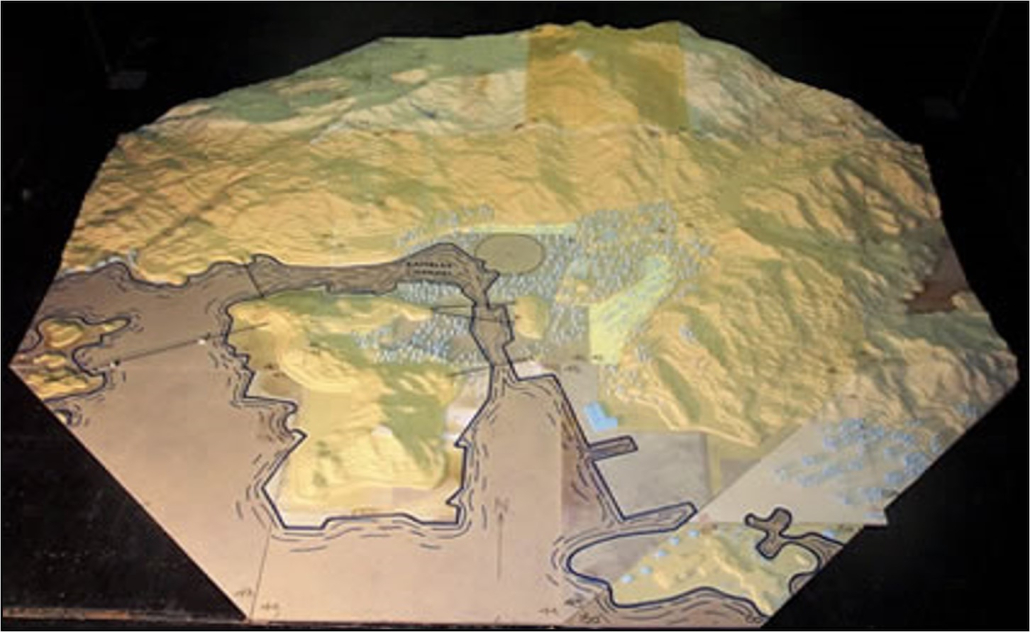
1:3000 Scale Topographic Model of Hong Kong
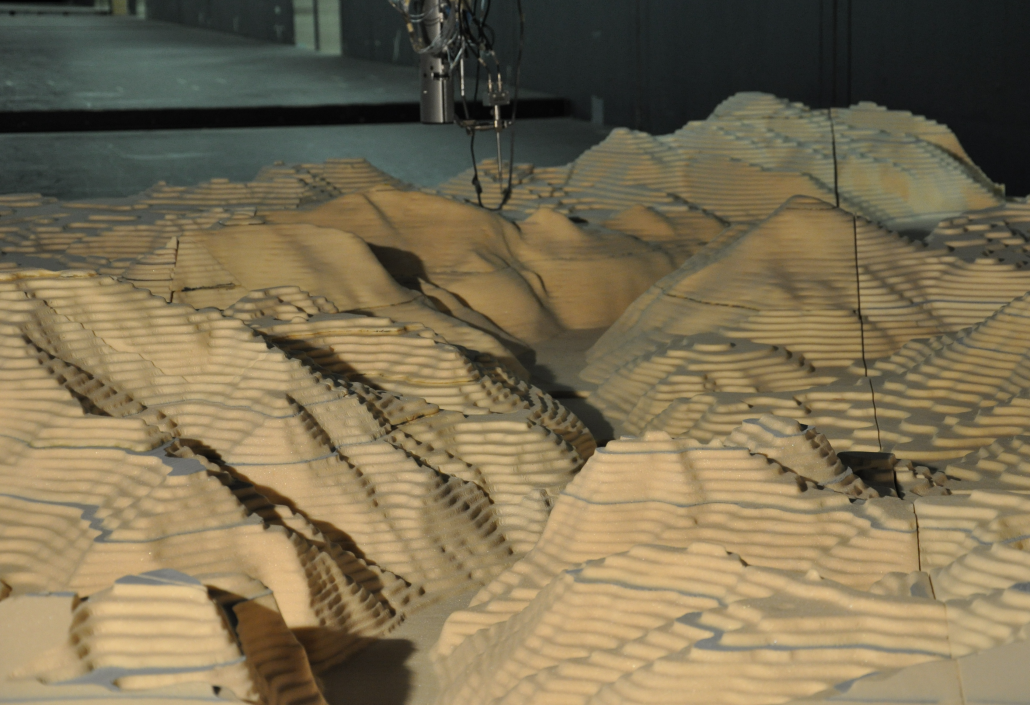
1:1200 Scale Topographic Model of the Colorado River
We assess the project site climate, considering local topography and historical wind measurements. We provide appropriate wind conditions for evaluation of the bridge.
We employ cutting-edge numerical simulation techniques such as Computational Fluid Dynamics to simulate flow conditions for pedestrian-level winds or topographic effects.
Connect with the Boundary Layer Wind Tunnel Laboratory to discuss your project’s unique design and challenges.
Western University
Faculty of Engineering
London, ON, Canada
1151 Richmond St., N6A 5B9
info@blwtl.uwo.ca
(519) 661-3338